Benchmark and comparison
Expanded four-way comparison: 184 attempts
The 2026-11-13 comparison covers 23 conditions × two repeats × four arms: seven personal browser conditions, ten isolated UI conditions and six crowded UI conditions. Every arm completed 46/46 raw task successes, with complete input and timing records. All-attempt and joint-success comparisons therefore use the same 46 condition/repeat cells; no failed cell is excluded.
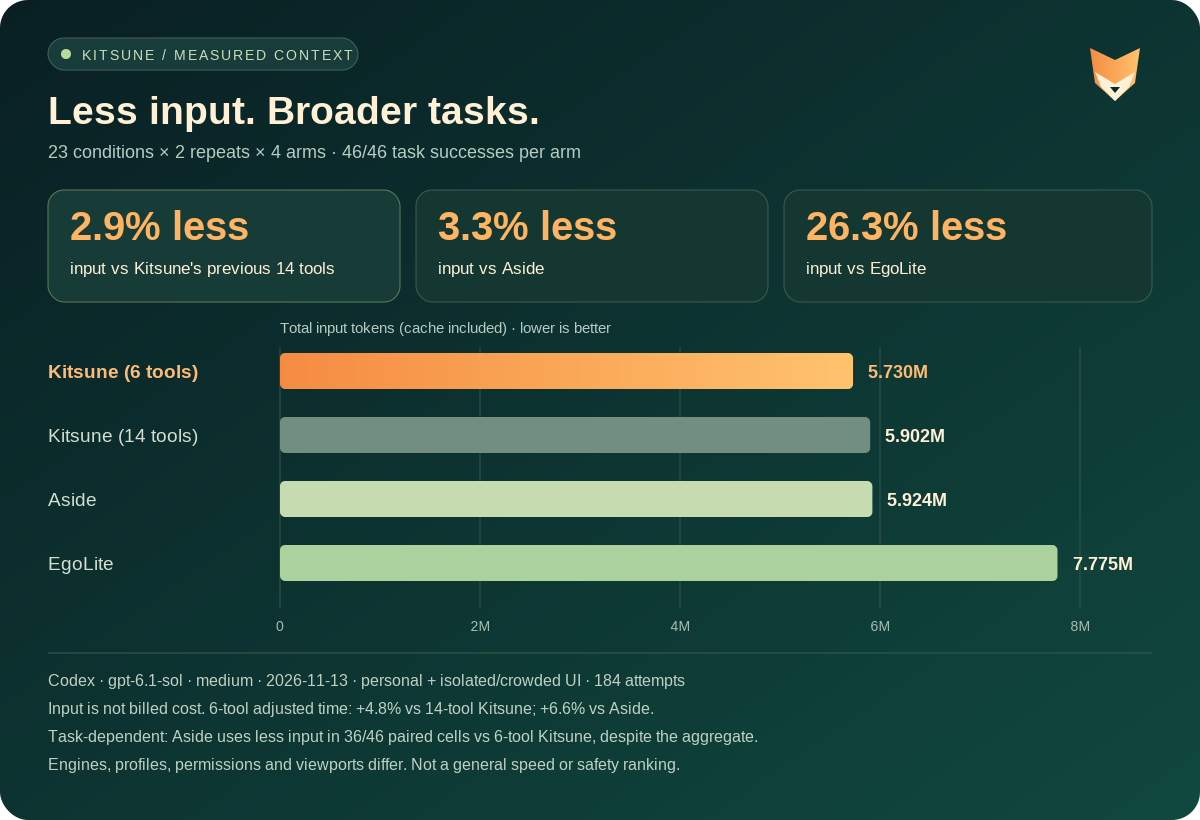
Input and elapsed time
| Arm | Raw task success | Input including cache | Raw elapsed, s | Adjusted elapsed, s |
|---|---|---|---|---|
| Kitsune 6-tool code-first | 46/46 | 5,730,439 | 1,396.084 | 1,324.975 |
| Kitsune previous 14-tool default | 46/46 | 5,901,946 | 1,333.899 | 1,264.414 |
| Aside | 46/46 | 5,923,875 | 1,444.198 | 1,242.744 |
| EgoLite | 46/46 | 7,775,055 | 1,627.307 | 1,478.044 |
Six-tool Kitsune uses 2.9% less total input than 14-tool Kitsune, 3.3% less than Aside and 26.3% less than EgoLite. These are aggregate cache-inclusive input tokens, not billed cost or subscription-quota savings. Monetary cost and model-request counts are unavailable for this cohort.
Less input does not mean faster: six-tool adjusted elapsed is 4.8% higher than 14-tool Kitsune and 6.6% higher than Aside, and 10.4% lower than EgoLite. Raw six-tool elapsed is 4.7% higher than 14-tool Kitsune. The predeclared adjustment subtracts measured relay setup and post-call inventory, not actual agent actions, images or approval delays. Both time columns sum individual agent runs, not whole-experiment wall time or isolated browser-operation latency.
Conditions and limits
- Codex CLI 0.163.0, requested
gpt-6.1-sol, medium reasoning, ChatGPT subscription. The same requested model and settings apply to all 184 attempts. Traces do not independently attest the backend model identity. This is a separate cohort from the older Opus studies below. - Kitsune runtime pins:
f5c7a0f85aefd89e621e73665e33d33d79d50676(six tools) and47dafa20a3fddc697a7d991e15d39e4b0232c10d(14 tools). Both already support Python; this is not Python versus no Python. The six-tool runtime was subsequently adopted onmainin #538, unchanged from the measured candidate; it is not part of the 0.8.0 release. - Aside CLI/native MCP 1.26.1107.24, app 1.0.1022.1, one
repltool. EgoLite CLI/app 0.6.2.9, onerun_scripttool with the predeclared image-attachment bridge. No Playwright or MiniWoB arm was run in this cohort, and no historical results are pooled into the chart. - Two repeats of variant 0, sequential rotated arm order. Personal limit 180 s, gallery 240 s; Kitsune MCP limit 45 s, vendor envelope 130 s around native 120 s scripts. No replacements, harness retries, missing final usage, quota stops or outcome-based tuning.
- Kitsune used fresh private Firefox and user-seeded read-only personal tabs. Aside/Ego used installed browser profiles and harness-created accessible tabs. Browser engines, effective viewports, profiles and ownership protections are not equivalent.
- Results vary by task and recovery outliers. Aside uses less input in 36/46 paired cells versus six-tool Kitsune despite its higher aggregate total. Six-tool input beats the old default in only 16/46 cells. Two repeats do not establish statistical superiority.
- The model runs made zero handoff or approval-recovery calls. Passing task/safety grades do not establish human-approval coverage, equivalent user-tab protection or confinement. Python/Node remain trusted host runtimes, not sandboxes.
Source: kitsune-benchmark/docs/results/2026-11-13-expanded-four-way-codex.md, report/audit commit
0c694d4a74fc1d0fba9d05c9c7a139aa5e697ce2, execution commit
e5db230a78ad006cfb8a12fbee6621b087a03e07. The figures and limitations are reproduced here so the
README comparison does not depend on access to the benchmark repository. The older interrupted
85/120 Opus A/B remains separate and incomplete; the new results do not replace its timeout.
Catalog size is not request-prefix usage
The offline six-tool catalog audit reassesses #521 against current
main and the separately pinned pending guidance stack. It measures serialized definitions,
not model-request tokens; the Codex cohort has no first-request-input or model-request count.
Earlier comparison: five-way MiniWoB
The 2026-11-12 exhibition compares Kitsune's default and legacy surfaces on the same source revision, alongside Playwright MCP, ego lite and Aside. It is seven tasks with two repeats per arm (70 attempts), not a completed standard-lite suite or an equal-environment leaderboard.
Shared successful cells
Every row below uses the same 13 task/repeat cells successful for all five arms. The one cell ego failed is removed from every arm. Input includes cache hits; these are token totals, not billed cost or browser-action counts.
| Arm | Input tokens, shared 13 cells | Raw success, all 14 attempts |
|---|---|---|
| Kitsune legacy | 785,115 | 14/14 |
| Playwright MCP | 781,019 | 14/14 |
| Kitsune default | 514,964 | 14/14 |
| ego lite | 458,052 | 13/14 |
| Aside | 361,014 | 14/14 |
- 34.1% less input than Playwright:
1 − 514964 / 781019. - 82.6% of the legacy-to-ego input gap closed:
(785115 − 514964) / (785115 − 458052). - 63.7% of the legacy-to-Aside input gap closed:
(785115 − 514964) / (785115 − 361014). - Kitsune still uses 12.4% more input than ego and 42.6% more than Aside on this set.
“Gap closed” compares default versus legacy on the same Kitsune commit, not progress across historical releases. It is not a claim of equivalent performance in every dimension.
Conditions and limits
- Claude Code 2.1.303, Claude Opus 5.5 (
claude-opus-5-5), medium reasoning, subscription. - Kitsune
79eb95594eee57bf429c1594c883f1995294dbc8: pre-release 0.8.0 code, not the final release tag. Default: 14 tools; legacy: 30 tools,KITSUNE_SCRIPTING=0; no benchmark allowlist. - Playwright MCP 0.0.83: 23 tools under the benchmark's standard UI allowlist. ego lite 0.6.2.9:
one
run_scripttool. Aside CLI/native MCP 1.26.1107.24 (app 1.0.1022.1): onerepltool. - MiniWoB
33c3b4ddef8c6eb67c57a29663d844b1eda7e614, seed 42. Tasks:click-test-2,click-checkboxes,enter-text,choose-list,login-user,use-autocomplete,book-flight. All planned attempts were scorable; no episode retries or replacements. ego failedbook-flightr1. - Kitsune made zero Python calls: this supports a smaller observed tool/prompt prefix, not a measured Python batching benefit. Across the full 14-cell Kitsune-only comparison, input fell 33.1%, but model requests rose 4.2% and MCP calls rose 2.3%.
- Kitsune/Playwright used fresh private headless Firefox. ego/Aside used installed warm browsers; engines, profiles and effective viewports were not equal. No isolation equivalence is claimed.
- Page-JS code was emitted in eight ego attempts and one Aside attempt, including successful attempts. These remain in the primary results; raw success is not strict UI-only compliance. On pairwise successful cells excluding page-JS use, ego/default input was 0.905 (6 cells), Aside/default 0.684 (13 cells). These smaller, selected subsets are not replacements for the chart.
- This small exhibition does not establish statistical superiority, approval safety, full-suite performance, or general speed/cost savings.
Source: kitsune-benchmark/docs/results/2026-11-12-five-way-main-79eb955.md, sections
“All-attempt totals” and “Matched efficiency, not success-blind totals”; benchmark execution
commit d75bbff586890f0857e6d947189ad0895fd7edf2. These historical figures are retained separately
and are not part of the current README chart.
Earlier benchmark: v0.7.2
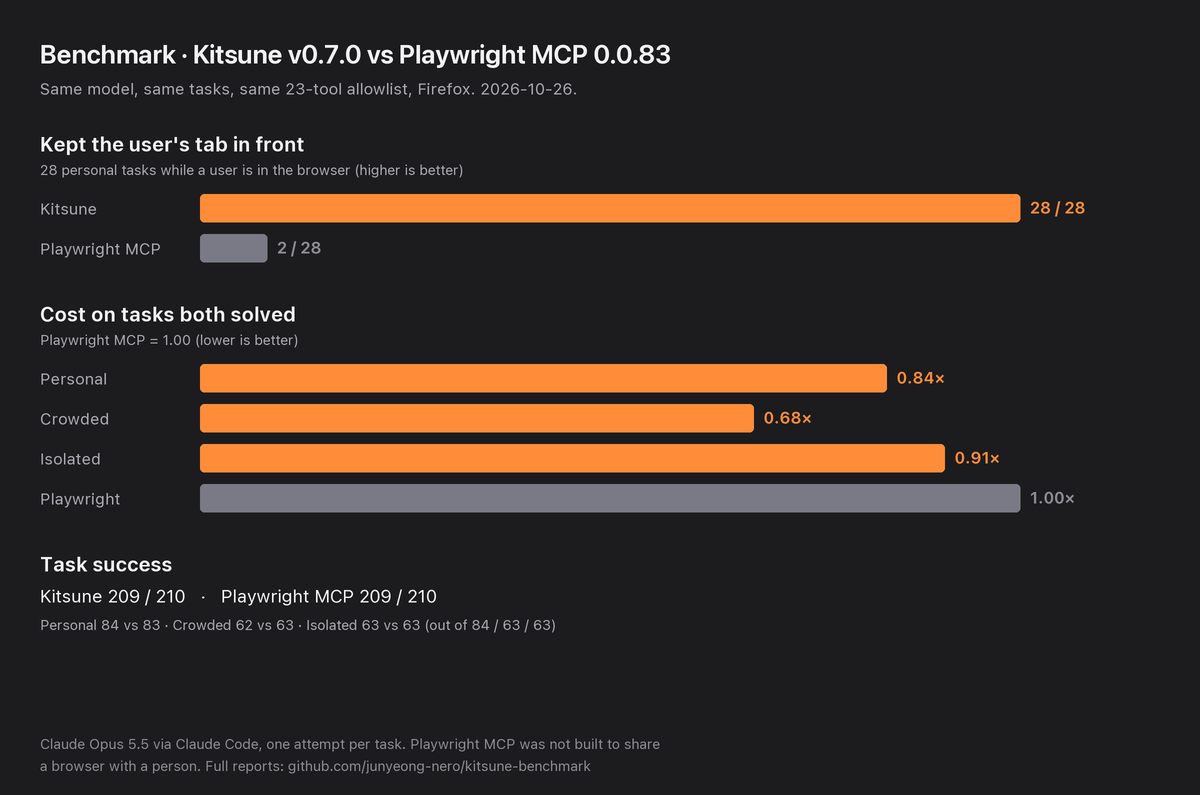
Same tasks, same model (Claude Opus 5.5), same tool allowlist, one run per task:
- Your tab stays in front. While a user was in the browser, Kitsune v0.7.2 never moved their view in 28 tasks. Playwright MCP, which was not built to share a browser with a person, moved it in 26.
- It costs less. On the tasks both solved, Kitsune cost 0.56 to 0.97 times as much as Playwright MCP.
- It solves about as many. Kitsune solved 96 of 98 tasks, Playwright MCP 98. Kitsune's two misses are one task, "go back to the tab I was on", in two variants: the user's tab stayed in front, but the agent's own tab was still its current tab, and that is what the grader checks.
See the v0.7.2 report
and the full reports.
scripts/benchmark_chart.py draws the chart from the report's numbers.
How is it different?
| If you want to… | Consider |
|---|---|
| Hand tasks to an agent in the Firefox-family browser you are using, with background tabs and per-tool approvals | Kitsune |
| Debug or profile pages in Firefox (debugger, profiler, deep protocol access) | Mozilla Firefox DevTools MCP, which attaches to a Firefox started with remote-debugging flags |
| Test across Chromium, Firefox and WebKit in browsers it launches | Playwright MCP; Kitsune uses the same core tools, so prompts carry over |
| Drive the Chrome you already use | A Chromium extension MCP such as Browser MCP |
Kitsune connects through an extension and a local bridge, so Firefox needs no startup flags. Other Firefox extensions also reuse your logins; Kitsune focuses on sharing the browser with you while the agent works. Positioning has the full comparison.